Posts tonen met het label Trends. Alle posts tonen

vrijdag 30 augustus 2019

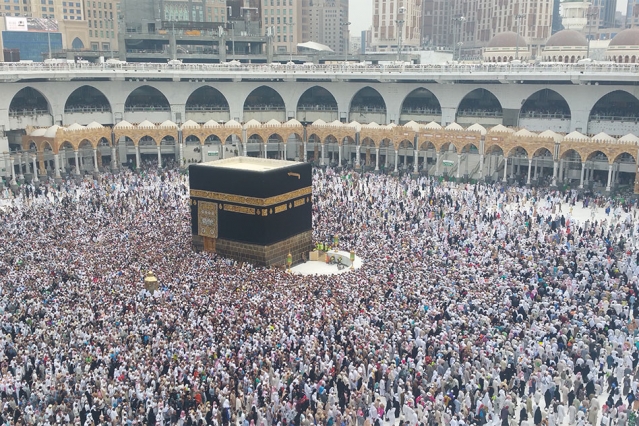
The climate and the Hajj


MIT news last week published a report on climate change and the Muslim pilgrimage Hajj: 


They concluded: "According to a new study by researchers at MIT and in California, because of climate change there is an increasing risk that in coming years, conditions of heat and humidity in the areas of Saudi Arabia where the Hajj takes place could worsen, to the point that people face “extreme danger” from harmful health effects."


The Guardian published an editorial: 

As climate crisis is endangering an age-old sacred rite, environmental stewardship is needed. 
"With approximately 100m plastic bottles left behind each year after the pilgrimage ends, it’s clear that action is desperately needed. "


dinsdag 22 augustus 2017

Tourists and Pilgrims: go home

Tourism is a for a long time contested concept:
Being imperial, unfair, rich-poor enhancing, hedonistic, naturedestroyer, culturedestroyer ....
And specific for pilgrimage routes like the Camino de Santiago the number of pilgrims are rising, new records crushed the next year.
Sure,  this increase is intentional, policy of national and regional government and of commercial corporations. A development that started some 40 years ago.


I looked around to provide you with additional and latest popular developments.
Looked at the pilgrimage route
Looked at some general touristic concerns.

Sometimes there just are too many tourists, too many pilgrims.
So, this blogitem provides an overview of the latest trend in tourism and pilgrimage alike: overcrowding.
And it hints alternative / sustainable tourism.


(China’s Qingdao Huiquan Beach during the height of peak season)


On the pilgrimage route

(photo: dpa Picture-Alliance / Florian Schuh / picture alliance / dpa Themendie)

The Camino de Santiago pilgrimage route saw it's routes becoming more and more crowded. 2017 probably again a record year. Experienced pilgrims use the usual comments: Try other routes or seasons, keep away from  the usual staged etappe endings, overcrowded camino was already an issue 30 years ago, it's nice, cosy and socially, it's not that bad. However: complaints are growing, even on the 'less walked' route like the Camino Ingles.
Like a pilgrim from Colorado just (august 2017, walked in july) reported on Tripadvisor: "Way to many people".
Some people don't mind, I do and try to keep away from overcrowded routes.

Four recent articles in French and German newspapers/sites cover the overcrowding.
( use google translate ;-)

Zu viele Jakobspilger: In Spanien wird gegen Urlauber protestiert
( Mass-tourism, we're off then. After Kerkeling's camino book Ich bin dann mal weg. Subtitle of the article: Too many pilgrims: Spain protesting against tourism)
Suddeutsche Zeitung

Pilgerstau am Jacobsweg
Far away from the peaceful tranquility, long human karavans on the way to the pilgrimage town of Santiago de Compostela are driving up prices and hunt away the locals
Die Presse

(This isn't tourismphobia, it's anticapitalism. In Spain activists torpede mass-tourism)
Francetvinfo


(Un graffiti "Touristes, rentrez chez vous" dans le centre-ville d'Oviedo (province des Asturies, nord de l'Espagne), le 7 août 2017. (ELOY ALONSO / AFP))


Große Zahl der Pilger sorgt für Ärger entlang des Jakobswegs
Large amount of pilgrims causes trouble along the Way of St James.
Hamburger Abentblatt (this article is published in many other magazins)


Tourisme generic
I'l start with a few headlines..

Is Mount Everest an overcrowded tourist trap?

Over-tourism in Amsterdam

You can click on them to go to the responding article


Protests are growing

Anti-tourism protests spread across Europe

Barcelona residents protest unchecked growth of mass tourism

You can click on them to go to the responding article


And to closeoff
"There is a growing backlash over tourism in Europe as the favourite hotspots suffer from chronic overcrowding and locals face rising prices for basic needs such as rent."
European tourism prompts locals to declare 'enough is enough' as visitor numbers grow
(Twitter Corse Tourism)


Just a few thoughts..


Picture Comparison Mass / Alternative Tourism


(Nompumelelo Mathebula, Univ of Johannesburg)


Picture Types of Tourism
(Cecilia Ryan, Understanding tourism impacts & types of alternative tourism)

dinsdag 18 juli 2017

Friluftsliv

This blogitem introduces you to the concept of Frilufsliv.
A fundamental understanding of men and nature.
A concept well known in Scandinavian countries, but becoming a trend elsewhere!

Enjoy what I gathered,
enjoy your compassion with and immersion in nature ;-)

Introducing

The following picture is a search on the concept in Google pictures:


Think you get an idea!

"What, then, is it? "
Mountaineering educator Nils Faarlund on Friluftsliv (in Encyclopedia of Religion and Nature and religion):
"“An unselfish I-Thou relationship that tries to come away from the anthropocentrism of a nature-dissonant society,” Faarlund concludes. Inherently, friluftsliv, as Faarlund, Ibsen, and Nansen want to define it, is a fundamentally spiritual belief that simply getting out into nature, enjoying the hike, the climb, the ski, the swim, is an essentially personal religious experience that gives the greatest possible meaning to human life."

Let's explore the concept more in two popular articles

MacsAdventure: 

"Friluftsliv, a word coined by Norwegian poet Henrik Ibsen, literally translating to ‘free air life’ is the word used to broadly describe the connection to nature that is so strong in Norway. This article explores how a respect and love of the outdoors is developed. "


McLendon on Mother's nature network:
"The Norwegian word, coined in 1859, has come to embody Norway's cultural enchantment with nature. It doesn't translate easily to English, but the basic spirit of friluftsliv hides inside all of us."
friluftsliv


Sit back and relax

Documentary by Charlotte Workman
"'Friluftsliv' is an ancient Nordic philosophy of outdoor life. It is an engrained philosophy in Norway and Sweden but relatively unknown to the rest of the world. This philosophy embodies the idea that returning to nature, is returning home."


See it on Vimeo, click here. It.'s 11 minutes long.


And finally if you want to go deeper I have some articles and a reference to a book:

Two articles if you want to read more..


"This article starts with a discussion of outdoor life as both a consequence of and a reaction against the industrialized and urbanized society. Thereafter comes a short presentation of the Nordic 2 outdoor tradition of "friluftsliv" (open-air life), including its "allemansrtt" (everyone's right of access to the countryside within certain limits). Finally the complicated issue of interaction between environmental experience and environmental perspective is raised and a preliminary model of the interaction between outdoor life and environmentalism is presented."


Abstract:
This paper explores the roots of the Scandinavian outdoor lifestyle of friluftsliv and its philosophical implication as well as its applications for environmental education. Friluftsliv as a philosophy is deeply rooted in Norway and Sweden but has lately obtained a more a superficial meaning by the commercialization of outdoor activities. The philosophy and biology of friluftsliv is explored showing its importance as a means, in environmental education, to facilitate a true connectedness to the more-thanhuman world. 

maandag 13 februari 2017

The Rewilding Movement

Perhaps the subject of this blogitem is an anthropocene subject par excellence ;-)
Want to know more about rewilding? Just read and look on for this quick introduction.


Afbeeldingsresultaat voor rewilding

"The short film (3’39) explains Rewilding Europe’s vision and approach to make wild nature a normal part of a modern Europe in the 21st century. Learn why we believe there is a historic opportunity to shape our natural landscapes of the future. Find out how rewilding can provide new perspectives for rural communities living in Europe’s countryside."


George Monbiot tells us in this Ted presentation on the reintroduction of wolves in the National Park Pick your own language...


However, read here a counter article on Popular Science 


But lets enter the core concept. See John Carey in the Proceedings of the National Academy of Sciences of the USA in his 2016 referenced article. (As long as they are allowed to publish scientific material ;-)
You can also download the pdf article there if you like.


Have a look at a pilot project of Rewilding Europe in Spain and Portugal: the case of Western - Iberia
(22:41)


Nice, the idea of forest that's to be feared, in contradiction to the 'view in the UK'!

A view from North-Rhine Westpfalia, wilderness in orderly Germany?
(4:17)


Another nice article is The Call of the Rewild
Ed Gibney in The Humanist 2016
Rewilding as a contra-concept to museum piece preservation of nature.

donderdag 31 maart 2016

Walk and Horreo

Sleeping in a Parador is perhaps not the place to sleep along the Camino de Santiago for a usual pilgrim.
But a traditional horreo, that's an option for the pilgrim living traditonal values, right?

Architect Nacho Gias from Madrid rebuilded four traditional horreos along the camino into luxurious 2 person cabins. (66$ a night)

By the end of 2016 two more are planned.


zondag 20 december 2015

Rural flight

Perhaps half of all abandoned villages in Spain are in Galicia. As processes of aging, rural flight (& urbanisation) and bad (economic) perspectives continue, this development will increase. Will immigration or tourism have an impact?
I collected some fine articles, a book and a movie on the subject.
So, if interested, go ahead ;-)

Population increase (red) or decrease (blue):


Have a look at this 13:11 documentary on Galician Ghost villages published by Celtico on the situation of the living landscape and on a family started to live in a former abandoned village.


See also this article in NPR (Aug 2015)

In Spain, Entire Villages Are Up For Sale — And They're Going Cheap

The abandoned village of O Penso, in northwest Spain, is for sale for about $230,000. The last resident died a decade ago. The village includes 100 acres with half a dozen houses, two sprawling farms with room for 70 cattle and a stand-alone bread-making kitchen.

or this one in Christian Science Monitor (Aug 2015)

For sale in Spanish 'paradise': entire villages. Cheap.


A Spanish exodus to the cities leaves a desert in its wake
(FT subscription field may popup)
The cemetery of Motos, one of many villages in Spain that has suffered from rural flight and depopulation


More information in
The Depopulation of Rural Spain in the Twentieth Century
by Fernando Collantes and Vicente Pinilla, 2011


In 'Reducing Depopulation in Rural Spain: The Impact of Immigration' the authors (Fernando Collantes, Vicente Pinilla, Luis Antonio Sáez and Javier Silvestre, 2013) discuss research on the impact of immigration that could lead to substantial reduction.


Immigration and depopulation is also subject of the article 
'Silent blight in a countryside of empty homes and shut shops'
in The Guardian (Aug 2015):
"Young people are leaving rural areas of Europe for the cities at a time when birth rates are at historic lows. As the countryside empties, should rising immigration be seen as a solution, not a problem?"