"No Mind is Scandinavia’s biggest alternative festival – a transformative gathering to open our hearts, become alive and free in our bodies, and relax into a wisdom beyond the mind."
Here's a look at last years event, hope it makes you happy.
Starting Aug 27, "Once a year, tens of thousands of people gather in Nevada’s Black Rock Desert to create Black Rock City, a temporary metropolis dedicated to community, art, self-expression, and self-reliance. In this crucible of creativity, all are welcome."
This year's theme is Radical Ritual, a temple will be erected.
Here's a movie of last year's event. What to expect...
Some weeks ago several news outlets published on a river in New Zealand getting the same legal status as humans have. In this contribution I'll bring you up to date. Inform you over some recent publications, get into the older ones. Have a look into some relevant organisations. Show you a nice TED presentation, and point you to two relevant concepts like ecovillages and buen vivir.
Also the Ganges and the Yamuna in India were given the status of living human entities. See The Guardian article here. And, while preparing this entry, I read on the Facebook page of Rebecca Solnit a link to Himalayan Glaciers and forests that have been declared human rights.
And likewise status changes are already performed elsewhere. But, what a contrast to discussions on legal status as human of unborn children. In fact, several organisations 'live on it' ;-)
Books For some background on the history of men-environment have a look at this book:
Roderick Nash, Wilderness and the American Mind
is a great book on the history of attitudes toward wilderness and the environment in the U.S..
“The Book of Genesis for conservationists”—Dave Foreman
Roderick Nash’s classic study of changing attitudes toward wilderness during American history, as well as the origins of the environmental and conservation movements, has received wide acclaim since its initial publication in 1967. The Los Angeles Times listed it among the one hundred most influential books published in the last quarter century, Outside Magazine included it in a survey of “books that changed our world,” and it has been called the “Book of Genesis for environmentalists
" Originally published in 1972, Should Trees Have Standing? was a rallying point for the then burgeoning environmental movement, launching a worldwide debate on the basic nature of legal rights that reached the U.S. Supreme Court. Now, in the 35th anniversary edition of this remarkably influential book, Christopher D. Stone updates his original thesis and explores the impact his ideas have had on the courts, the academy, and society as a whole. At the heart of the book is an eminently sensible, legally sound, and compelling argument that the environment should be granted legal rights. For the new edition, Stone explores a variety of recent cases and current events--and related topics such as climate change and protecting the oceans--providing a thoughtful survey of the past and an insightful glimpse at the future of the environmental movement. This enduring work continues to serve as the definitive statement as to why trees, oceans, animals, and the environment as a whole should be bestowed with legal rights, so that the voiceless elements in nature are protected for future generations. "
"Fighting for Our Shared Future: Protecting Both Human
Rights and Nature’s Rights explores 100 case studies from
around the world of co-violations of nature’s and people’s
rights."
TED
See also the TEDx Findhorn presentation by Mumta Ito:
"by enshrining Rights of Nature in law, we protect the environment that we all need for our very existence."
2016
(14:18)
Added May 13 2017: Have perhaps also a look at this article on Ecologist
I would like to introduce two further concepts, ecovilages and buen vivir.
Ecovillages
"Kosha Joubert shares how community-led regeneration can become a source of solutions for today’s societal challenges. Kosha takes us on a journey around the globe to discover ecovillages, envisioning a world of empowered citizens and communities, designing and implementing their own pathways to a sustainable future, and building bridges of hope and international solidarity."
Have a look at TEDx Geneva's presentation.
2015
(15:22)
Buen Vivir
Familiar with the concept of buen vivir? Does the good living comes from South America?
This 'nature rights concept' "departs from a social philosophy, known in Spanish as “buen vivir”, in which the concept of a good life proposes a holistic approach to development that intertwines notions of unity, equality, dignity, reciprocity, social and gender equality – a rallying cry to move beyond Western ideals and practices of development and progress largely measured by profit."
I'm interested in landscape and experience. In movement and affect, where the senses reach out...
Today I would like to introduce a man walking the pilgrimageroute to Santiago.
But... Sven is blind and deaf.
He is determined to walk the camino to Santiago de Compostela.
He talks with his hands, he feels with his feet.
He grasps the world at arms length.
Showing the world what is possible.
2017
Susanne Bohlmann
(4:04)
"Sven is nearly 50 but he has long dreamed of walking the Camino de Santiago. Sven was born deaf and became completely blind 10 years ago. Despite this and his reliance upon his assistants, Almuth and Sabine, he is driven by his need for independence. From his small, 3rd floor apartment, near the German Black Forrest, he sculpts wooden animals from his memory. He programmes his own website and treks through the nearby mountain wilderness. His hands and feet are now his first line of contact; they experience the textures and map the ground which his assistants carefully describe.
But Sven is not an easy man; his determination is hard to keep up with. Now he wants to challenge himself; trekking 500 miles over mountain, down through the lowlands to the sea. It was an impossible dream until he persuaded Almuth to do it with him. In spring 2017 his wanderlust will reach up through the Pyrenees. Sven and his assistants will walk the entire width of Spain along the Pilgrims Way of St James. Sven will not relent until reaching Cape Finisterre; the cape at the end of the earth. Sven has been straight with us; he won’t wait for us, neither camera nor Assistant will hold him back. It’s a bold statement perhaps as much to himself as to us."
Sean Yoro (Hula) used chalk and water to paint these murals somewhere in the forests of the Pacific Northwest. A message on wildfire, deforestation and climate change.
"The artwork is called Puliki, which means 'to embrace' in Hawaiian."(cnn)
Perhaps the subject of this blogitem is an anthropocene subject par excellence ;-) Want to know more about rewilding? Just read and look on for this quick introduction.
"The short film (3’39) explains Rewilding Europe’s vision and approach to make wild nature a normal part of a modern Europe in the 21st century. Learn why we believe there is a historic opportunity to shape our natural landscapes of the future. Find out how rewilding can provide new perspectives for rural communities living in Europe’s countryside."
George Monbiot tells us in this Ted presentation on the reintroduction of wolves in the National Park Pick your own language...
Nice, the idea of forest that's to be feared, in contradiction to the 'view in the UK'! A view from North-Rhine Westpfalia, wilderness in orderly Germany? (4:17)
Does the Slow Movement ring a bell? This item is on the slow movement, slow travel inclusive an iconic landscape travel TV, mindfull slow movement...
This movement started with slow food ,
but rapidly expanded in many other cultural fields, including slow travel.
Well, by now you perhaps know I'm studying aspects of pilgrimage, landscape, movement and experience. So, I want to guide your attention on a spin-off. The nice concept of slow travel or slow tourism as an example of performed transmodernity. A concept related to backpacking, eco-tourism and volunteer tourism. A concept related to pilgrim/tourist traveling.
Encountering a new lifestyle.
Here are a few pointers...
Introduction
Wikipedia: "The slow movementadvocates a cultural shift toward slowing down life's pace. It began with Carlo Petrini's protest against the opening of a McDonald's restaurant in Piazza di Spagna, Rome in 1986 that sparked the creation of the slow food movement. Over time, this developed into a subculture in other areas, like the Cittaslow organisation for "slow cities". The "slow" epithet has subsequently been applied to a variety of activities and aspects of culture."
Ted presentation by
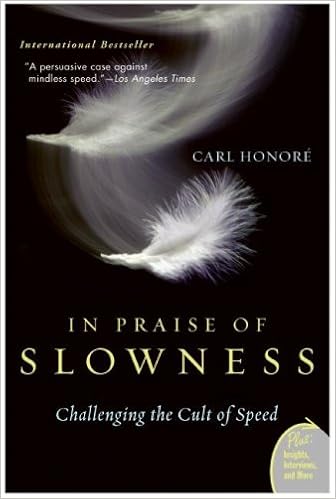
Carl Honore: In praise of slowness
(20:00)
Manifesto
"Slow travel is about making conscious choices, and not letting the anticipation of arrival undermine the pleasure of the journey. By choosing to travel slowly, we reshape our relationship with place and with the communities through which we pass on our journeys. In 2009 we launched our 'Manifesto for slow travel'."
Carl Honoré, journalist and author of In Praise of Slowness, talking about Slow Travel
(7:59)
Carl Honore
Slow Travel,
presentation from Verena Erin
SLOW - A short film about van life- English version
Because life’s too short to live too fast.
"Synopsis: Two couples traveling around the world in two camper vans decide to discover the Ecuadorian jungle together. Through a word game they realize that everything is interconnected. This short film is a reflection on the structures Western society forces upon us.
Directed by: Marta Tibau and Marià Miño"
(9:59)
Mmviatges - Furgo en ruta
Topping off
How can we deal with the addictive nature of speed? Carl Honoré, Gervais Williams, Deepa Patel and Kate Fletcher explore how we can improve our quality of life, well-being and creativity by applying the principles of slow.
The slow revolution
RSA
(17:43)
And finally if you have some time to spend. The Bergen line to Oslo, an iconic slow-TV program in 2009. See the slow slowly changing landscape. (7:14:13)
More on mindfull walking is said and written by Thich Nhat Hanh .
The miracle of walking on the earth.
Perhaps here is a clue on taking the 'camino experience' home, at least partly! See more on this website article 'From pilgrimage to walking meditation'
There are several 'slow' related books like..
(and many articles...)
An article on pilgrimage and slow travel from these books can be found on Academia: " We are
pilgrims through time - Augustine
The path of modernity is one
characterized by acceleration, interconnection and mobility. Amidst the
increasingly fast tempo of life in late modernity, contemporary pilgrims and
other ‘slow travellers’ express needs and desires for alternative experiences
of temporality, while subverting the dominant ‘cult of speed’. My objective in
this chapter is to focus on issues of temporality in exploring three aspects of
slow travel: the potential contradictions it presents, its direct relationship
to modernization and its link to pilgrimage."



![Slow Tourism: Experiences and Mobilities (Aspects of Tourism) by [Markwell, Kevin, Fullagar, Simone, Wilson, Erica]](https://images-na.ssl-images-amazon.com/images/I/51IckA5zYHL.jpg)